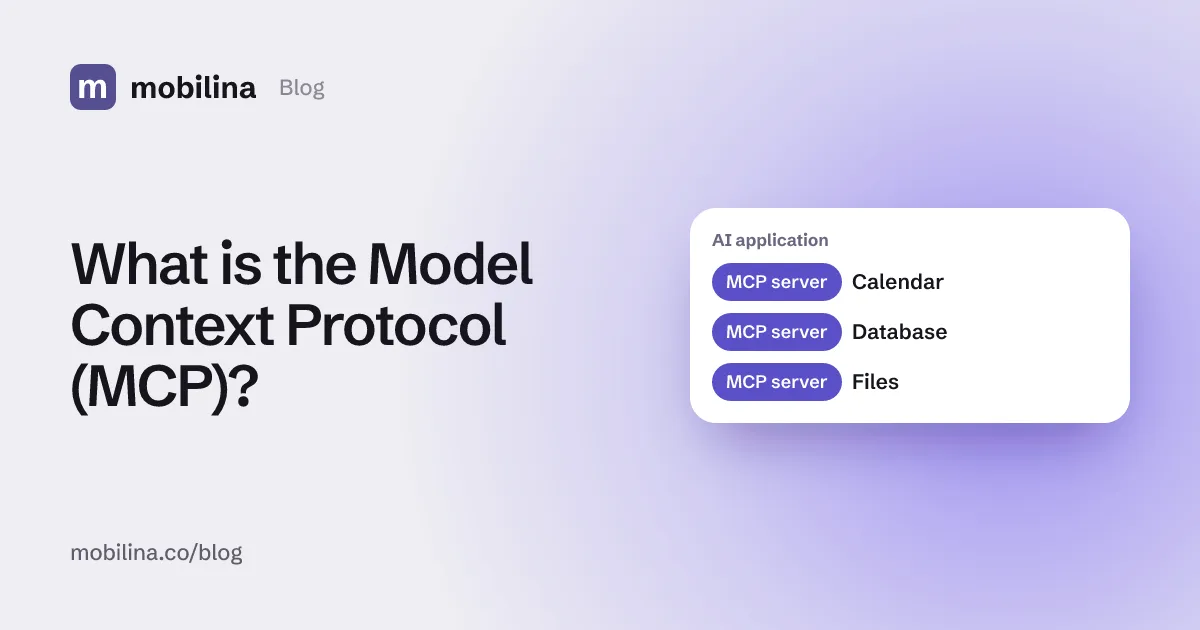
Short answer: The Model Context Protocol (MCP) is an open standard that defines how AI applications connect to external systems: data sources such as files and databases, tools such as search or calculators, and workflows such as ready-made prompts. Anthropic introduced it on November 25, 2024, and the project’s documentation compares it to a USB-C port for AI applications. Instead of building a separate integration for every assistant and every system, a system exposes an MCP server once and any MCP-compatible application can use it.
The problem it solves
When Anthropic announced MCP, it described a familiar situation: even capable models are cut off from the data they need, because it sits in separate tools and older systems, and every new data source needs its own custom integration. That doesn’t scale. MCP replaces those one-off connections with one shared protocol.
How it fits together
The MCP documentation describes three participants:
- Host: the AI application the person uses, for example a desktop assistant or a code editor.
- Client: a component inside the host. The host creates one client for each server it connects to, and each client keeps its own connection.
- Server: a program that provides context and capabilities. It can run locally on the same machine or remotely as a service.
Servers offer three core building blocks, called primitives:
| Primitive | What it is | Example |
|---|---|---|
| Tools | Functions the AI application can call to take an action | Run a database query, call an API |
| Resources | Data that gives the model context | File contents, a database schema |
| Prompts | Reusable templates for interacting with the model | A system prompt, few-shot examples |
The documentation’s own example is a database server that offers query tools, the database schema as a resource and a prompt with worked examples. Servers can also ask the user for more input or for confirmation of an action, through a feature called elicitation.
Messages use JSON-RPC 2.0. Local servers usually talk over standard input and output on the same machine; remote servers use the Streamable HTTP transport, and the documentation recommends OAuth for obtaining access tokens.
Who supports it
According to the documentation, MCP is supported by AI assistants such as Claude and ChatGPT and by development tools such as Visual Studio Code and Cursor. Anthropic’s launch included the specification and SDKs, local server support in Claude Desktop, and open-source servers for systems such as Google Drive, Slack, GitHub, Git, Postgres and Puppeteer.
What MCP does not do
The documentation is explicit that MCP only covers how context is exchanged. It does not decide how an application uses a language model or what it does with the context it receives. Good answers still depend on good instructions, good data and limits on what the model may do.
What to watch before connecting a business system
An MCP server can give an AI application real access to your data and real ability to act. Before connecting one:
- Give the minimum access. A server that only needs to read orders shouldn’t be able to cancel them.
- Require confirmation for risky actions. Anything that changes, deletes or pays should ask a person first.
- Treat what the model reads as untrusted. Content pulled in through a server can contain instructions aimed at the model; see prompt injection.
- Know who runs the server. A remote server operated by a third party sees the requests you send it.
Summary
- MCP is an open standard for connecting AI applications to data, tools and workflows.
- A host creates one client per server; servers offer tools, resources and prompts.
- It standardises the connection, not the judgement: access limits and confirmations are still your job.