
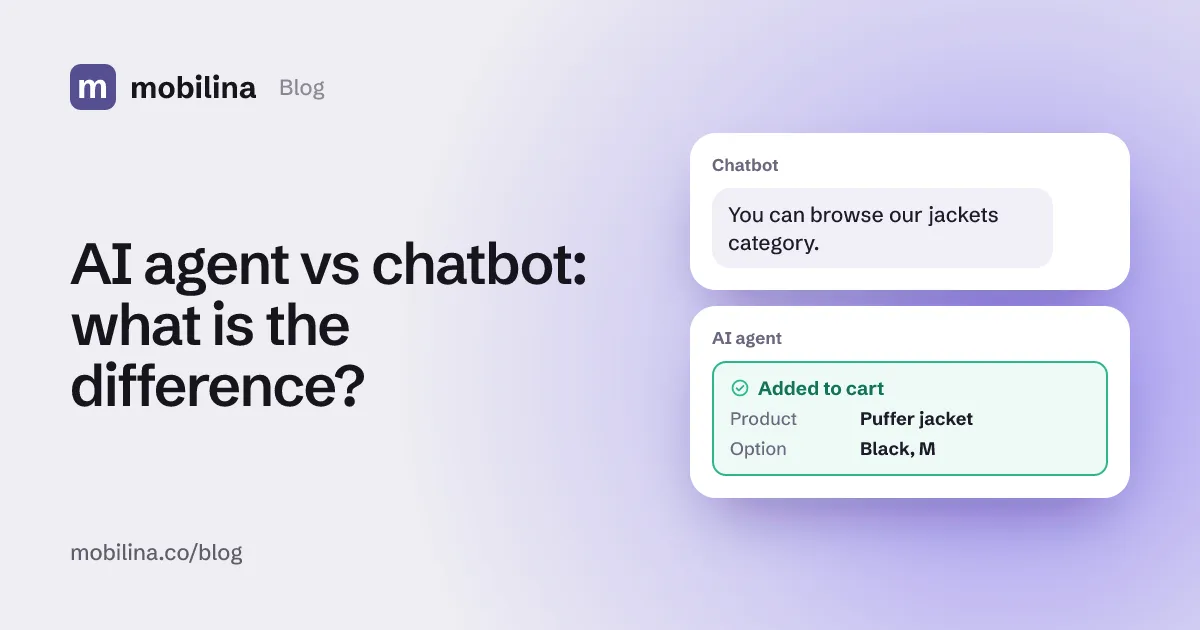
Short answer: A chatbot replies to messages, usually from scripted answers or a menu of options. An AI agent uses a language model to decide what to do next and then does it: it looks up information, calls tools in connected systems, and finishes a task such as adding a product to the cart or booking an appointment. The practical test is simple. When the conversation ends, has the work been done, or has the customer just been given a link?
How the people who build the models define an agent
OpenAI’s A practical guide to building agents describes agents as systems that independently accomplish tasks on a user’s behalf. The same guide says that applications which use a language model but don’t let it control how a workflow runs, “think simple chatbots”, are not agents.
The guide lists two characteristics. An agent uses the model to manage the workflow and make decisions, including recognising when the task is complete and stopping to hand control back when it fails. It also has tools for reading context and taking actions in external systems, and it picks the right tool for the current step within defined guardrails.
Anthropic’s Building effective agents draws a similar line. Workflows follow predefined code paths. Agents let the model direct its own process and tool use.
Chatbot vs AI agent at a glance
| Rule-based chatbot | AI agent | |
|---|---|---|
| Where answers come from | Pre-written replies and decision trees | The business’s own catalog, policies and documents, read at the time of the question |
| Free-form questions | Works well inside the patterns it was built for | Understands questions phrased in natural language |
| Taking action | Usually sends a link or a form | Creates the record in the connected system: cart, calendar, help desk |
| When it doesn’t know | Falls back to a menu or a generic reply | Stops and hands over to a person, ideally without guessing |
| Maintenance | Every new case needs a new rule | Mostly maintained by updating content, instructions and tools |
The same question, handled two ways
A shopper on a clothing store’s website writes: “Do you have the hooded puffer jacket in black, size M?”
- A typical chatbot recognises “jacket” and replies with a link to the jackets category, or asks the shopper to pick from a menu. The shopper still has to find the item, check the size and add it to the cart.
- An AI agent searches the live catalog, confirms the colour and size are in stock, adds the item to the cart, and points the shopper to checkout. The shopper confirms the purchase on the store’s own payment page. The agent doesn’t take the payment.
This second flow is the one described for product search on Agenola, the AI agent in Mobilina’s portfolio. It finds what the shopper wants in the catalog, asks for size and colour, adds the item to the cart and sends the shopper to checkout.
When a chatbot is enough
Not every website needs an agent. Anthropic recommends starting with the simplest solution that works and adding complexity only when it clearly improves the result. OpenAI makes the same point: if a task can be handled with fixed rules, a deterministic solution may be enough.
A scripted chatbot or a good FAQ page is often the right choice when:
- the questions are few and predictable (opening hours, delivery areas, return window),
- every answer can be written in advance,
- no record has to be created in another system.
When an agent is worth it
OpenAI’s guide names three kinds of work where agents add the most value. All three show up in customer conversations:
- Decisions that need judgement, with exceptions and context. The guide’s example is approving a refund in customer service.
- Rule sets that have become hard to maintain, where every change is costly and error-prone.
- Work that relies on unstructured data: understanding natural language, extracting meaning from documents, or talking with users.
For a business website, this usually means product questions that need the live catalog, bookings that need the real calendar, and applications that require collecting the right details and documents.
What keeps an agent under control
An agent can act, so the limits matter as much as the capabilities. Both guides describe the same kinds of safeguards:
- Clear instructions and guardrails about what the agent may and may not do.
- Human hand-off. OpenAI names two triggers for human intervention. The first is exceeding a failure limit, such as not understanding the customer after several attempts. The second is high-risk actions such as cancelling orders, authorising large refunds or making payments. Anthropic describes agents pausing for human feedback at checkpoints or when they hit a blocker.
- Stopping conditions, such as a maximum number of steps, so a task can’t run on indefinitely.
- Answering from the business’s own information rather than general knowledge. When the information isn’t there, the right answer is to pass the conversation to a person.
Agenola follows this pattern. It answers only from the business’s catalog, policies and added knowledge, and when it isn’t sure it opens a request for the team or a ticket in the help desk instead of guessing.
Summary
- A chatbot replies; an agent decides the next step and acts in connected systems.
- If your questions are predictable and no record has to be created, a chatbot or FAQ is enough.
- If conversations should end with a sale, a booking or a completed application, an agent is worth evaluating. Look for one with clear guardrails and a human hand-off.
Agenola is a product in Mobilina’s portfolio. The definitions and recommendations above come from the OpenAI and Anthropic guides listed below.